

Every time Google rolls out a core algorithm update, the same question comes up for site owners: is my website ready for it, or is it about to lose rankings overnight? A Google core update isn’t a random event; it follows patterns that can actually be measured, from EEAT signals and PageRank distribution to Core Web Vitals thresholds. This guide breaks down exactly what changes during a Google search algorithm update, how to audit your site against it, and what to fix before the next one lands.
I. Understanding Google Core Updates and the Core Ranking Formula
That measurable pattern starts with how Google actually scores a page. Core updates are automated recalibrations of how Google evaluates content quality across the entire web, not manual penalties aimed at individual sites . When rankings move after a core update, it’s rarely because Google “targeted” a specific page. It’s because Google’s internal quality signals were retrained, and pages that no longer match the new baseline shift position, up or down.
A simplified way to think about how Google weighs a page:
Ranking Score = (Relevance × Intent) + EEAT Score + PageRank − UX/Spam Penalties
Note the subtraction at the end. Even a page with strong relevance and a solid EEAT score can lose ground if UX problems or spam signals pull the score back down.
One concept worth understanding here is information gain. If your page says the same thing as the ten results already ranking above it, in the same order, with the same examples, there’s no reason for Google to move it up. Pages that add something the existing results don’t already cover tend to hold rankings better through these updates.
II. Key Ranking Formulas and Frameworks Google Evaluates
1. PageRank Link Authority Formula
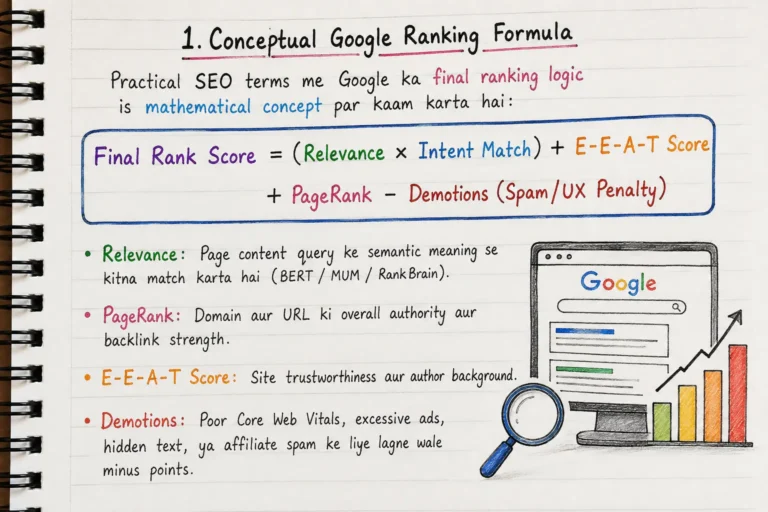
PageRank still forms part of how link equity gets distributed, even though the public scoring tool disappeared years ago. The underlying math looks like this:
PR(A) = (1 − d) + d × [PR(B)/L(B) + PR(C)/L(C) + …]
In plain terms, a page’s authority comes from the pages linking to it, divided by how many outbound links each of those pages has. This is why linking out to low-quality pages or picking up spammy backlinks dilutes your site’s overall authority. Every link, internal or external, is either reinforcing your PageRank distribution or leaking it somewhere it doesn’t need to go.
2. The EEAT Quality Evaluation Framework
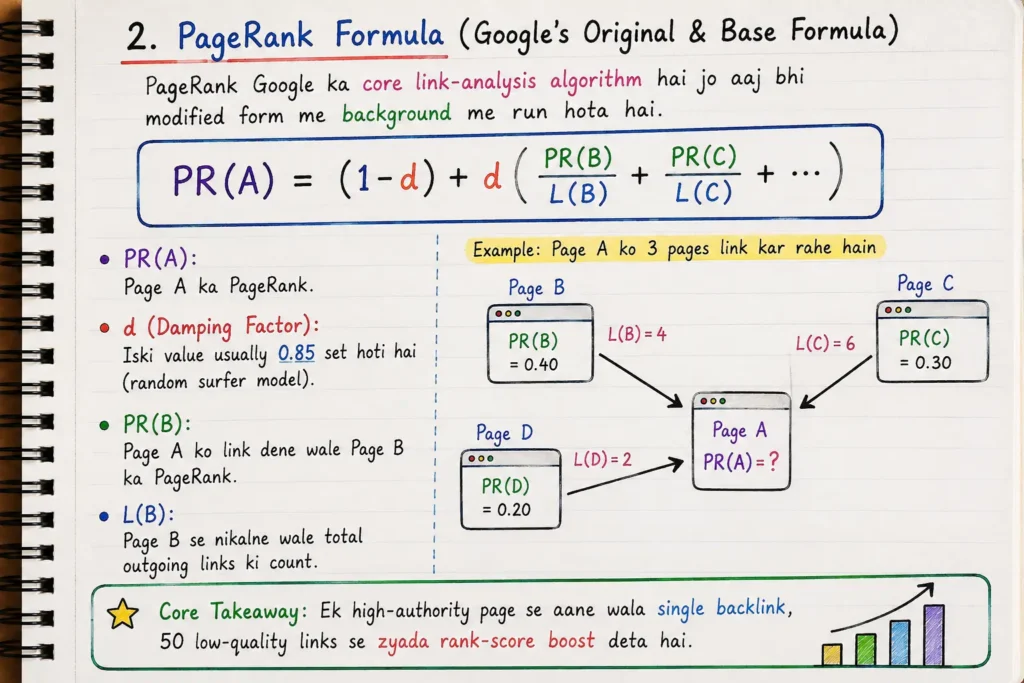
EEAT breaks down into four parts.
- Experience covers first hand evidence: original photos, proprietary data, and actual hands on testing, not information copied from another source.
- Expertise covers formal qualifications, subject matter knowledge, and a visible author background.
- Authoritativeness covers industry citations, mentions from other reputable sites, and general brand reputation.
- Trustworthiness sits at the center of the framework. Sourcing, site security, clear editorial policies, and contact transparency all feed into it, and weakness here tends to pull the other three down with it.
One detail worth flagging: pages in YMYL content categories (health, finance, legal) get held to a stricter version of this framework, roughly five times stricter in terms of expected proof of expertise. A general blog post about a hobby and a page giving financial advice are not judged by the same bar, and treating them the same is a common mistake.
3. Core Web Vitals Thresholds (Technical Performance Metrics).
Three thresholds matter most right now.
- LCP (Largest Contentful Paint): target of 2.5 seconds or under. This measures how fast the main content on a page finishes loading.
- INP (Interaction to Next Paint): target of 200 milliseconds or under. This measures the delay between a user clicking or tapping and seeing visual feedback.
- CLS (Cumulative Layout Shift): target of 0.1 or under. This measures visual stability, specifically whether elements jump around on the page while it’s loading.
These aren’t vanity metrics. They’re baked into how Google evaluates page experience, and a page that fails all three Core Web Vitals thresholds is fighting an uphill battle regardless of how good the content is.
III. Step-by-Step Google Core Update Self-Audit Process
Step 1: Identifying Impacted Pages
Compare performance data across 30-day, 60-day, and 90-day windows. This separates normal seasonal movement from an actual quality adjustment tied to a core update. Then check whether the drop is isolated to specific topics or categories, or whether it’s spread across the entire domain. The pattern tells you a lot about where to focus.
Step 2: Evaluating Individual Page Quality
Run what’s sometimes called the competitor comparison test. Look at the pages now outranking yours and ask a direct question: what specific information, visuals, or original insight do they include that your page doesn’t? Not “is their page longer,” but what’s actually different in substance.
At the same time, run a redundancy check. Look for internal pages covering nearly the same topic. These pages often compete against each other for the same query, splitting authority instead of building it.
Step 3: Taking Corrective Action
Three moves cover most situations.
Updating: add fresh facts, improve formatting, add clear author details, and include original media where the page currently relies on generic stock content.
Consolidating: merge multiple thin or overlapping pages into one page that actually covers the topic properly.
Pruning: remove pages that are outdated and low quality, and add nothing for visitors. Keeping them active can drag down how Google views the rest of the domain.
IV. Practical Troubleshooting Guide for Ranking Drops
Drop across the entire site. Usually points to a diluted overall quality footprint, or poor PageRank distribution across the domain. Fix: audit content domain wide, prune thin posts, and fix internal linking so authority flows to the pages that matter most.
Drop on YMYL advice pages. Usually points to a weak EEAT score or missing expert backing. Fix: add clear author bios, cite primary sources directly, and include expert reviewer credits where relevant.
Drop in user engagement. Usually points to a Core Web Vitals failure, whether that’s high LCP, high CLS, or slow INP. Fix: improve image formats, clear up layout clutter, and cut down JavaScript that blocks rendering.
V. Complete Google Core Update SEO Checklist
- Content passes the EEAT test, meaning it includes real first hand experience, an author bio, and cited sources.
- Internal linking distributes PageRank effectively toward priority pages instead of spreading it evenly across everything.
- LCP sits under 2.5 seconds, with no lazy loading on hero images and key assets preloaded.
- INP sits under 200 milliseconds, with the main thread kept clear and JavaScript tasks broken into smaller pieces.
- CLS sits under 0.1, with explicit width and height attributes set on images and video embeds.
- The page fully resolves what the user searched for, without filler or keyword stuffing padding it out.
Want to Master Google Core Update Recovery and Technical SEO?
A checklist explains what to check. Applying EEAT, PageRank distribution, and Core Web Vitals fixes correctly on a live site is a separate skill, one that usually takes structured practice to build. WSQ Search Engine Optimisation (SEO) course in Singapore covers ranking formulas, audit frameworks, and the technical fixes involved in recovering from a Google core algorithm update.