

A keyword tells you what someone typed into a search bar. It does not tell you why they typed it. That gap is the real difference between ranking for a term and actually helping the person behind it.
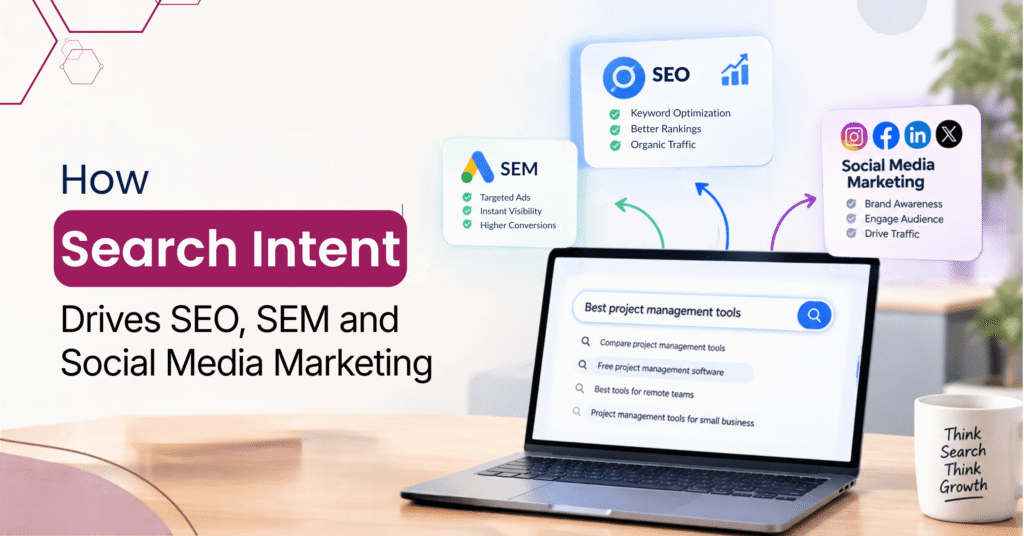
SEO answers search intent with organic content built around what a searcher wants to do. SEM answers the same intent through paid search: bidding on queries, writing ads, and sending users to landing pages that match their stage in the decision process. Social media marketing works differently. It relies on audience interests, behaviour and demographics rather than a typed query. So the same marketing goal can need a different approach depending on the channel.
Search intent is the reason behind a search query. Understanding it helps marketers pick the right keyword, content format, ad, landing page and channel. SEO and SEM work mainly from search behaviour, while social media marketing leans more on audience and behavioural signals. Understanding how search intent affects Digital marketing helps marketers adapt their strategy to how people discover and interact with content across different channels.
What Is Search Intent?
Search intent is what a user is actually trying to do, not just the words they typed.
A search query is the literal text entered into a search engine. Search intent is the goal behind it. Sometimes it is explicit: a query like “buy running shoes online” states the action clearly. Other times it is implied: “running shoes” could mean the person wants to learn about types, compare brands, or is ready to buy. The same keyword can carry different intent depending on wording and where the searcher is in their decision process.
This is why intent should be identified before content gets written. A blog post for a query that actually reflects transactional intent, or a product page for a purely informational query, both end up ranking for the wrong reason and fail the person who lands there.
Example: The query “Excel VBA” could mean several things: learning what VBA is, finding code examples, researching training options, or looking for a specific course. Each of these needs a different type of page.
The Four Main Types of Search Intent
Informational Intent:
The user wants to learn something. Queries like “what is VBA?”, “how does SEO work,” or “how to use Excel macros?” fall here. The expected format is guides, tutorials and blog articles, not a sales page.
Navigational Intent
The user wants to reach a specific website or page. Examples: “Google Search Console” or “Facebook Ads Manager”. These searches usually have one clear destination.
Commercial Investigation
The user is comparing options before deciding. Queries such as “SEO course vs digital marketing course” or “best SEO tools” fall here. Suitable content includes comparisons, reviews and course pages.
Transactional Intent:
The user is ready to act. Examples: “enroll in SEO course” or “book digital marketing training”. This calls for course pages, registration pages, or pricing pages built for a decision already made.
How Search Intent Shapes SEO
Search intent affects almost every layer of SEO strategy, starting with keyword selection. A keyword with high search volume only helps if the intent behind it matches what the page delivers.
Before targeting a search term, check the current SERP. If the top results are guides and tutorials, the query signals informational intent, no matter how the keyword itself reads. If product or service pages dominate, the intent is likely commercial or transactional.
A useful way to approach on-page SEO is
Keyword → Intent → Content type → User expectation
An informational query needs informational content. A commercial query needs comparison content. A transactional query needs a course or service page. Placing the target keyword in the title and body is not enough on its own. If the format does not match what the searcher expected, the page may struggle to maintain its visibility even if it ranks initially.
Search intent also shapes heading structure, the type of examples used, and whether a call-to-action belongs on the page at all. For informational queries, understanding how to read SERP signals instead of relying on search volume alone is an important part of WSQ Search Engine Optimisation (SEO) training.
How Search Intent Influences SEM
In paid search, search intent matters even more directly, because every click costs money. Search queries show intent in real time, and that should guide which keywords get targeted, how they are grouped, and what the ad copy says.
Not all keywords are equal. High-intent keywords, ones closer to a decision, usually convert better. Low-intent keywords can rack up clicks without conversions. Checking the actual search terms people used, not just the target list, helps spot which queries burn budget without results. This is where negative keywords come in: excluding terms that do not match the intent being bid on.
Ad relevance and landing-page fit both depend on reading intent correctly. If the ad promises information but the landing page pushes a hard sell (or the other way around), the mismatch raises the bounce rate and lowers the quality score.
Example: Compare “What is SEO?” with “SEO course Singapore”. The first shows information-seeking behaviour; the person is early in their research. The second shows stronger commercial or transactional intent; the person may be comparing providers or looking for a suitable course. The ad, landing page and CTA for each should reflect that. These are core considerations in WSQ Search Engine Marketing (SEM) training, where keyword grouping, search-term analysis and ad relevance are closely connected to campaign performance.
Search Intent vs Audience Intent in Social Media Marketing
Social media works differently from search because users are not always actively looking for something. On search channels, users actively state a need through a typed query, while on social platforms they may discover content based on their interests and behaviour.
SEO / SEM → Search query → Intent
On social platforms, it works the other way. Users are not typing what they need; they are scrolling, engaging, and being shown things based on signals collected about them.
SMM → Audience signals → Content/Ad exposure → Interest/Action
Those signals include interests, behaviour, demographics and engagement history. A social campaign built around a course does not wait for someone to search for it. It finds an audience segment likely to be interested and puts relevant content in front of them.
Social media is not entirely without search intent. Users do search within platforms, and that reflects intent too. But traditional social media marketing, both organic content and paid targeting, depends more on audience and behavioural signals than on a typed request. Audience segmentation is a key part of WSQ Social Media Marketing (SMM) training, much as keyword research is central to SEO. Segmentation helps define which people are most relevant to a particular piece of content or campaign.
Search Intent vs Audience Intent: Key Difference
Factor | Search Intent | Audience Intent |
Signal | Search query | Behaviour, interests, context |
Main channels | SEO, SEM | Social media marketing |
User action | Actively searches | May discover content passively |
Targeting | Keywords, search terms | Audience characteristics, signals |
Content | Matches query | Matches audience interest |
Measurement | Rankings, CTR, conversions | Reach, engagement, conversions |
Search intent is what a person is trying to accomplish through a search. Audience intent is how likely a particular audience is to care about a topic, product or message.
How One User Need Can Be Addressed Through SEO, SEM and SMM
Take a simple need: “I want to learn digital marketing.”
SEO: Informational content answers the questions this person is likely asking: what skills matter, what digital marketing involves, and how the channels connect. Built to rank for research-stage queries.
SEM: Paid search targets users whose query wording, like “digital marketing course Singapore”, shows they have moved past research and are comparing or ready to enroll.
SMM: Educational content, short videos or targeted campaigns reach people who fit the profile of someone interested in this skill set but who have not searched for it yet.
The underlying need can be the same across all three channels, but the way people discover and respond to the content is different. This is why SEO, SEM and SMM work best when they respond to the same audience at different stages, not as separate efforts.
How to Match Search Intent With the Right Content
Intent | User Expectation | Suitable Content |
Informational | Learn | Guide or tutorial |
Navigational | Find | Brand or specific page |
Commercial | Compare | Comparison or review |
Transactional | Act, buy, enrol | Landing page |
Intent should decide content format and page purpose, not just keyword choice. Two pages can target the same keyword and still fail if one is built for the wrong stage of the decision.
How to Identify Search Intent Before Creating Content
Step 1: Read the query. What is the user actually asking, beyond the literal words?
Step 2: Check the SERP. See which pages rank, how titles are written, whether People Also Ask boxes appear, and what format dominates.
Step 3: Name the dominant intent. Informational, navigational, commercial, or transactional?
Step 4: Match the format. Does the SERP call for a blog post, a guide, a comparison, or a course page?
Step 5: Build the page around the expectation. Answer the real need, not just the keyword.
Common Search Intent Mistakes
- Picking keywords by volume alone, without checking intent
- Skipping the SERP before deciding on format
- Writing an informational post for a query that is actually transactional
- Sending informational searches to a sales-heavy landing page
- Treating every keyword variation as separate intent when they mean the same thing
- Reusing content across SEO, SEM and SMM without adjusting for each audience
- Chasing rankings without checking if users are satisfied once they land
How to Measure Whether Your Content Matches Search Intent
SEO: Organic click-through rate, relevant organic traffic, on-page engagement, conversions from organic visits.
SEM: Click-through rate, search-term performance, conversion rate, cost per acquisition, return on ad spend.
SMM: Reach, engagement, click-through rate, lead generation, downstream conversions.
Traffic alone does not prove intent was satisfied. A page can rank well and get strong traffic while still missing the need behind the query. Engagement and conversions show whether the content actually matched what the user wanted.
Conclusion: Match the Strategy to the User's Intent
The goal is not to choose SEO, SEM or SMM simply because one channel looks better on paper. It depends on what the audience needs and how they express that need—through a search query on Google or through their behaviour on social platforms. Understanding how search intent affects SEO, SEM and social media marketing helps businesses create content that fits each channel instead of using the same approach everywhere.